Monthly Archives: March 2015

‘Let the Snorter Be Covered in Soot’: Ancient Board Game Inscriptions

‘to hunt, to bath, to play, to laugh — This is to live!’

Insightful article on the what the peripheral writings on ancient game boards can tell us about the people who played with them.

What will future generations learn from the games in your collection? Do you embellish your games or will they pass into history with no trace of their owners? Will Legacy-style games prove to be the greatest future window into the lives of board gamers of today?

I’ve got a game set in Ancient Rome coming out at Essen this year. I’m going to see if we can add some fun “inscriptions” to the game board artwork as a playful call back to these historical game players.

Be sure to click through and read the full article:

sarahemilybond's avatarSarah E. Bond

☩ μὴ θεόμαχος νήων. ☩

☩ ἀσβολόθη ὁ ῥονχάζων. ☩

Let the snorter / be covered in soot!

[MAMA X, 330=PH 269278]

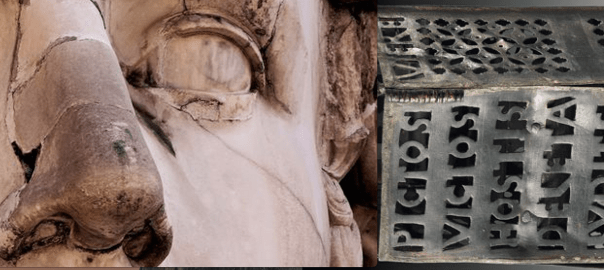
Games of chance are never a silent endeavor; however, Romans found it rather uncouth to snort when Fortune was not on your side. A civil person kept their nose silent. There is a strong auditory component to board and card games even today (think about your own favorite cuss words or perhaps a nicely placed ‘yo mama’ joke), just as there was in antiquity. An inscription from late antique Phrygia (4th-5th c. CE) in fact gives us some idea of the insults hurled in the late ancient world. On the edges of a game board adorned with crosses, no less, we have the insult: ‘μὴ θεόμαχος νήων’ (for ναίων), ἀσβολόθη (should be ἠσβολώθη) ὁ ῥονχάζων–essentially, let the snorter go straight to hell. Clearly the crosses were there for protection and luck, and not as a show…

View original post 811 more words
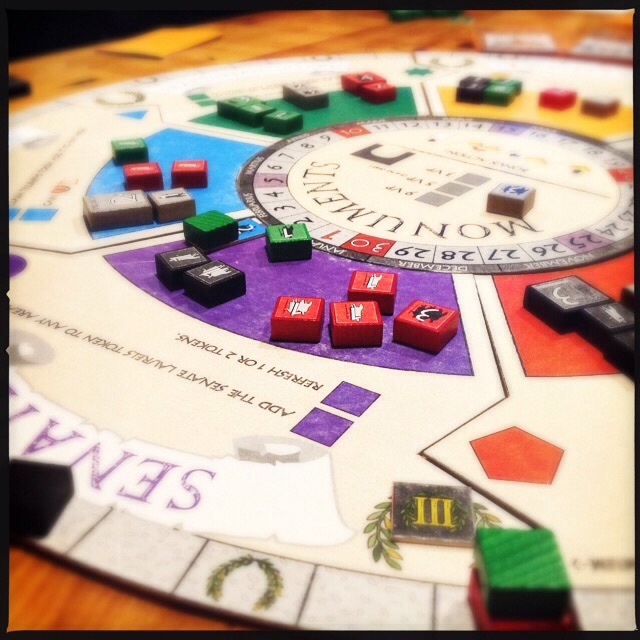
a quick peek at more of the LXIX prototype


I picked up the rest of the prototype pieces I’m printing at The GameCrafter. They look great. The cardboard tokens are replacing the wood blocks in my current prototype. They’re less expensive, easier to produce and modify, and more portable.

My next step is to update the LXIX game board. It’s a non-standard shape, though, so I can’t have it printed at TGC.

LXIX_at_Board_Games__Beer.JPG

LXIX has a circular board with six interchangeable pieces in the outer ring and one round center board. I’d like the outer ring sections to lock together like puzzle pieces so they don’t move when bumped. To accomplish that with some measure of precision, I’m planning to have the pieces laser cut at The Bodgery, a hacker space here in Madison.

I’ll lay out the cut template in Illustrator and export it to DXF format – a CAD file – and send that to the laser cutter, which will can the board pieces out of very thin plywood. I’ll print the images on waterproof full-sheet Avery labels and cut them by hand before applying to the plywood blanks. I should end up with a fine looking, precision-cut board.


I love games and history.

I love games and history, and I love learning history through the medium of games.

That’s why I’m enchanted with Fujian Trader, a game about Chinese merchant trading families in the 17th Century. It was inspired by co-designer Robert Batchelor’s own discovery of the Selden Map, a cartographic masterpiece from the early 17th Century.

From the Oxford Digital Library’s Treasures of the Bodleian:

Dating from the late Ming period, it shows China, Korea, Japan, the Philippines, Indonesia, Southeast Asia and part of India. The map shows shipping routes with compass bearings from the port of Quanzhou across the entire region. A panel of text on the left of the map near Calicut, its western extremity, gives directions of the routes to Aden, Oman, and the Strait of Hormuz. This is the earliest Chinese map not only to show shipping routes, but also to depict China as part of a greater East and Southeast Asia, and not the centre of the known world.

Here’s an excerpt from the Fujian Trader Kickstarter page:

Fujian Trader is a gateway strategy game based on a recently re-discovered 17th century trading map of East Asia uncovered in the archives of Oxford University’s library. The map, which is the oldest Chinese maritime merchant map still in existence, is currently touring East Asia, and is now considered one of Oxford’s greatest treasures. The map shows the routes used by Chinese traders across East Asia, and as a player you get to travel these routes once again. Fujian Trader’s co-designer Robert Batchelor, a professor of British History, is credited with finding the map and bringing it to the attention of geographers, historians and the greater public. Batchelor is on a mission – “I want to make the map and its rich history accessible and intriguing to a larger audience. I believe we can do this with Fujian Trader by getting players to learn about the map and experience its’ meaning through play.”

Learning history through play!

The campaign creators have put their money where their mouth is with a nominal $10 reward geared toward teachers, which includes a pdf download of their lesson plan for Fujian Trader, covering the history of the Selden Map and its impact on both Asia and Europe, and a stretch goal that would provide 100 free copies of the game and their East Asian geography and history lesson plan for middle schools.

That’s a strong commitment to education and learning through games.

If you like good and accurate historical games like I do, please take a few minutes to check out the Fujian Trader Kickstarter campaign. From what I’ve been able to glean from their game play videos and updates, Sari Gilbert and Robert Batchelor have designed a game worth backing.


FWIW, I have no vested interest in this game and I don’t know the creators. I’m simply eager to play this fascinating game and, in order for me to do so, their campaign must succeed!

Want to learn more about the Selden Map?

Read the articles from the Wall Street Journal or The Economist. You can also find out more at Oxford University’s site.

LXIX prototype cards have arrived!

A selection of LXIX influence cards.


I stopped in at the GameCrafter after work to pick up the first deck of cards for my LXIX prototype. They look awesome! Cant wait to get them on the table.

I should probably photograph them in better light soon.


A selection of Leader cards from LXIX.


A selection of Spoils of War cards from LXIX.


a cool coin-cidence


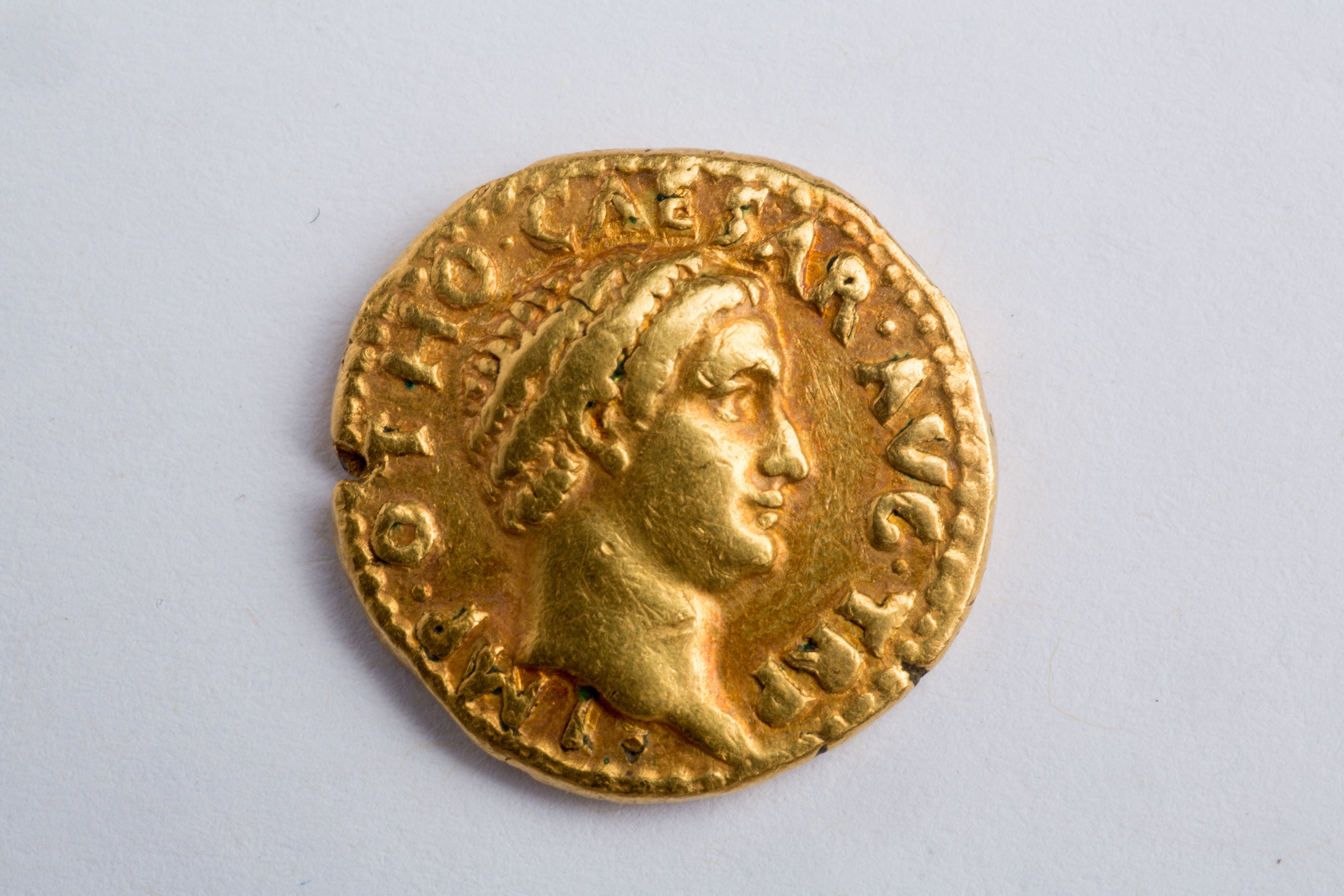
This is an image of a “remarkably rare” gold coin from very short reign of the Roman Emperor Otho, who ruled for only three months in the year 69.

It is part of a collection of  Ancient Roman and Greek coins recently re-discovered in the Library of the University at Buffalo.

As my dear readers already know, I’m putting the finishing touches on a game called LXIX: The Year of Four Emperors. For those of you who don’t know, LXIX is 69 in Roman numerals. Otho is one of the titular Four Emperors in my game!

It gives me a real thrill to see this tiny piece of history surface while I’m working on a game about the very period in which it was minted. Just imagine! A Roman general seizes the throne in one of Rome’s most turbulent years, but only manages to hold onto power for three months before sacrificing his own life to save Rome from a terrible civil war.

Yet this tiny coin, minted in the brief time Otho ruled as emperor, survived for more than nineteen centuries to end up tucked away in a case, deep in the archives of a library in Buffalo, New York, hidden away and forgotten until a curious assistant professor of classics chased down a rumor and brought it to light. Wow!

Just seeing his noble face peering out from the centuries gives me chills.